
What is SEDS-ÉEDS Canada?
Space Industry Opportunities in 2026 Abound for the Students and Early-Career Professionals by SEDS-Canada
By Riyana Afroze and Ahmad Khan
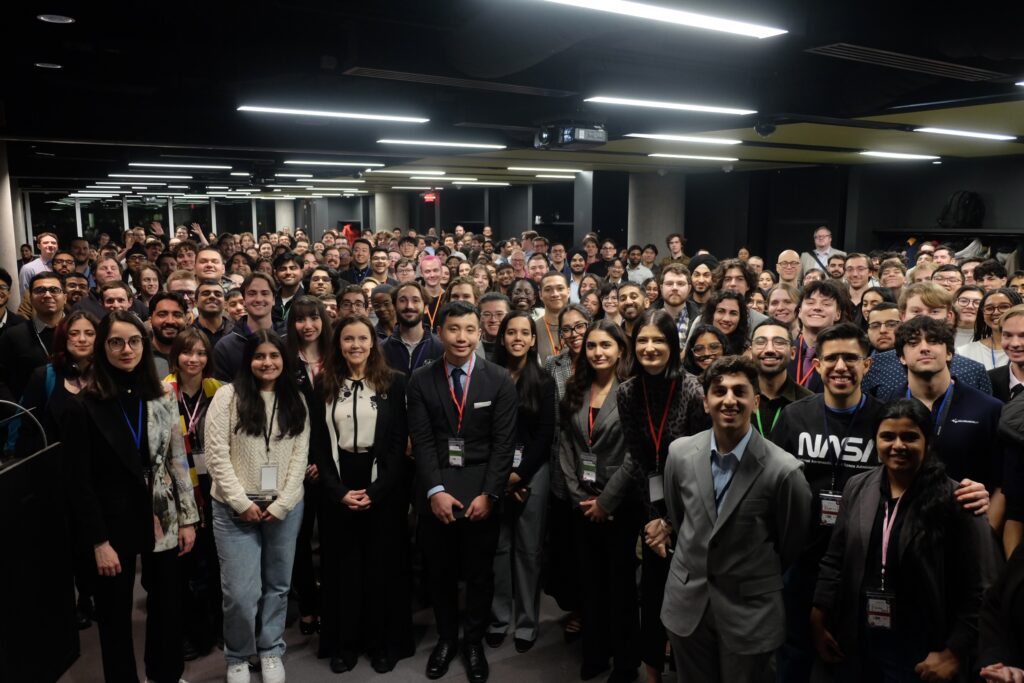
SEDS-ÉEDS Canada offers students and early-career professionals a wealth of opportunities to get involved in everything from high-altitude balloon experiments to microgravity research and entrepreneurship challenges.
The national non-profit is set to release the following major initiatives for the Canadian space community across 2025, in addition to occasional local events near regional chapters.
CAN-SBX: The Canadian Stratospheric Balloon Experiment
The Canadian Stratospheric Balloon Experiment (CAN-SBX) offers a unique opportunity for post-secondary students to explore science and technology at high altitudes. This design challenge aims to inspire undergraduates to push the boundaries of what is possible by conducting experiments in Earth’s stratosphere.
What Is the Project About?
The CAN-SBX Design Challenge allows students to design and test a small scientific experiment flown on a high-altitude balloon provided by the Canadian Space Agency. Participants can develop experiments in astrophysics, Earth’s atmosphere, Earth’s magnetic field, biology, remote sensing, or technology demonstrations.
Who Is Eligible?
Any undergraduate student enrolled at a recognised post-secondary institution in Canada may enter this competition.
Graduate students may join a team but cannot form one independently.
Important Notes:
At least one team member must be a member of SEDS Canada. Students are required to provide proof of enrollment when submitting their proposal.
When Does It Roughly Happen?
The project is currently underway and was launched in late 2025.
CAN-SBX is generally launched around late October each year.
Where Does It Happen?
The stratospheric balloon launches take place in Timmins, ON.
Why Should People Participate?
Participants gain valuable STEM skills by designing an experiment and conducting research in an environment where atmospheric conditions differ greatly from the surface
CAN-RGX: The Canadian Reduced Gravity Experiment
The Canadian Reduced Gravity Experiment (CAN-RGX) Design Challenge focuses on microgravity research. It provides students with the chance to fly their experiments aboard a specially modified aircraft, simulating reduced gravity conditions.
What Is the Project About?
In collaboration with the National Research Council (NRC) and the Canadian Space Agency (CSA), post-secondary student teams design and test small scientific experiments on the NRC Falcon 20. The aircraft simulates microgravity conditions by flying in consecutive parabolas. Two members of each team get to fly with their experiments on board.
Who Is Eligible?
Any student enrolled at a recognised post-secondary institution in Canada may join.
Important Notes:
At least one team member must be a member of SEDS Canada. Students are required to provide proof of enrollment when submitting their proposal.
When Does It Roughly Happen?
The project is currently underway and was launched in late 2025.
CAN-RGX is typically launched around late October each year.
Where Does It Happen?
The current flight campaign is at the NRC’s Flight Research Lab in Ottawa, ON.
Why Should People Participate?
Students gain invaluable STEM experience, the thrill of flying on board a parabolic aircraft, and the chance to conduct research in microgravity—an environment impossible to replicate on Earth.
YSpacE: The Young Space Entrepreneurs Competition
The Young Space Entrepreneurs Competition (YSpacE) fosters entrepreneurship in the Canadian space sector. It challenges post-secondary students to create viable business ideas that address real problems the industry is facing, while simultaneously offering them an avenue to develop crucial business and management skills.
What is the Project About?
The YSpacE competition requires participants to formulate a business plan focusing on a space-related product or service. Through webinars and mentorship, students refine their proposals and learn how to commercialise their concepts. By registering into the YSpacE program, students get access to:
- Award-winning startup masterclass fully covered
- Webinars with subject matter experts from different sectors and backgrounds
- One-on-one mentorship with industry experts
- Bi-weekly check-ins with YSpacE staff members
- Opportunity to pitch live at YSpacE finals
- Cash prizes for the top 3 winners of the YSpacE pitch competition
Who Is Eligible?
Any student enrolled at a recognised post-secondary institution in Canada may apply.
Important Notes:
- At least one team member must be a member of SEDS Canada.
- Proof of enrollment must be provided at the time of proposal submission.
When Does It Roughly Happen?
This year, YSpacE is taking place as a 10-week sprint between January and March 2026.
Where Does It Happen?
YSpacE’s final pitch will be held at the Canadian CubeSat Conference in Montreal in March 2026.
Why Should People Participate?
Students can contribute directly to Canada’s space sector by creating solutions for actual industry challenges, turning their innovative ideas into profitable ventures.
The Canadian CubeSat Network (CCN)
CCN was created for anyone working on a CubeSat project, people who have previously worked on CubeSats or those simply interested in them. By joining the network you can unlock several exclusive benefits:
- Vibrant Discord community: Connect with peers to share ideas and troubleshoot challenges.
- Curated wiki: Access credible CubeSat resources in one place.
- Mentorship & alumni connections: Gain guidance from experienced CubeSat team leads and professionals.
- Exclusive lecture videos: Watch MDA Space sessions on mission planning and concept of operations (CONOPS).
- Canadian CubeSat Conference discounts: Members receive reduced registration for the Canadian CubeSat Conference.
- Additional perks for teams: CubeSat team leads can register their team as a CCN associate for extra perks and outreach opportunities.
Who Can Participate?
CCN membership is open to anyone in Canada (as well as SEDS chapter members outside of Canada) with a passion for small satellites. Students currently working on CubeSat, CanSat or SmallSat projects, alumni who have flown missions in the past, educators, researchers and space enthusiasts are welcome. The network is designed to foster collaboration across disciplines and experience levels.
How to Join & Upcoming Events
You can sign up through SEDS‑Canada’s website to access the online community and resources. The network’s flagship event is the Canadian CubeSat Conference, a technical gathering dedicated to CubeSat projects. The 2026 edition will be held at the John Molson School of Business at Concordia University in Montréal from March 7–8, 2026. CCN members benefit from discounted registration. The conference will spotlight CUBICS teams and other Canadian satellite design projects, with technical presentations, research posters, networking sessions and alumni fireside chats.
Why Should You Participate?
Joining the Canadian CubeSat Network allows you to:
• Unleash creativity: Collaborate on cutting‑edge small‑sat challenges.
• Gain mentorship: Learn from experienced industry experts and CubeSat alumni.
• Network nationally: Connect with peers and industry leaders across Canada.
• Access exclusive training: Tap into lecture videos and resources to build mission‑planning skills.
• Drive real impact: Contribute to building Canada’s satellite‑technology workforce and expand the socioeconomic uses of space.
• Engage in events: Attend the bi‑annual Canadian CubeSat Conference and other CCN‑sponsored activities at a reduced cost
About the authors
Riyana is a 4th-year Mechatronics Engineering student studying at Memorial University of Newfoundland. As the Deputy Projects Chair at SEDS-Canada, Riyana plays an instrumental role in overseeing coordination between the Project Managers and Coordinators of the four national projects (CAN-RGX, CAN-SBX, YSpacE, and the Canadian CubeSat Network) and the organization’s Board of Directors. She has been a member of the SEDS-Canada Board of Directors since January 2025 during which she re-launched YSpacE (Young Space Entrepreneurs Competition) and pioneered the Canadian CubeSat Network. Riyana is also a Co-Founder and Co-Chair of Women of SEDS (wSEDS) and was instrumental in delivering the first-ever conference celebrating women in the space sector in Canada, last July.
Ahmad is an aspiring mathematician studying pure mathematics at Wilfrid Laurier University. He is the Projects Chair at SEDS-ÉEDS Canada, responsible for oversight of all of the non-profits’ national projects, which have a strong focus on research & engineering initiatives. During his spare time, he loves to play chess and billiards and is an aspiring mathematician with hopes of studying differential geometry and topology in the future.