
When Poetry Meets the Search for Alien Life
By Mya McKinnon
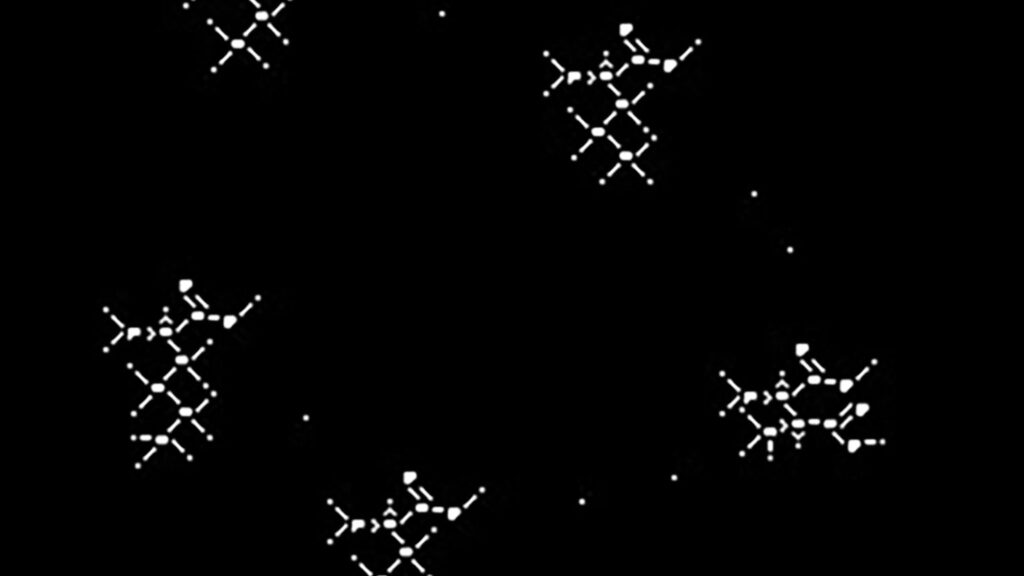
Photo Courtesy of NASA.
The presence of extraterrestrial life within the cosmos is one of humanity’s largest curiosities. The study of astrobiology has many unique fields that search for the possibility of life, and one of those fields is making that first contact with an unknown form of intelligence. Scientists around the world produce and analyze satellite signals in preparation for the inevitable.
The Search for Extraterrestrial Intelligence (SETI) Institute funded a project by Daniela de Paulis in collaboration with NASA and the European Space Agency (ESA) called A Sign in Space. The SETI Institute is a non-profit research organization that leads the search for life and intelligence in our universe.
In 2023, A Sign in Space sent a simulated alien message from the ExoMars Trace Gas Orbiter, an ESA satellite orbiting Mars, to Earth. This signal could be picked up from any satellite, leaving the message for any citizen to decode.
Brock University Professor, Gregory Betts, was one of four people in the world who created this viral alien message. Betts is not only the Undergraduate Officer in the Department of English Language & Literature, but also the Literary Arts Residence Lead at the SETI Institute’s Artist in Residence program.
An in-depth interview with Betts revealed how he ironically got involved in an out-of-this-world project as an English professor. It all started from a comment on Twitter about a course he taught at Brock titled How to Speak to Aliens.
Betts said, “I posted a comment about the course on Twitter and it came up on Bettina Forget’s feed,” who is the Director of the Artist in Residency Program at the SETI Institute. “I don’t know how it got to her. But she saw it, wrote me a message, we started talking, and she was fascinated.”
Forget then invited Betts to A Sign in Space project meeting filled with NASA scientists and astronauts. “We hit it off really well. She liked that I wasn’t part of that orbit already… I guess that’s a pun,” Betts chuckled.
Professor Betts became a crucial member of this project. The message team figured out how to write a message “that would not be overly shaped by humans in a non-human voice,” as Betts puts it. His first attempt to write the message was a poem called Stars Poetica. This poem did not end up getting selected for A Sign in Space, but rather another project called the Lunar Codex. Betts’ poem became the first and only poem scheduled to be embedded on the surface of the Moon.
The Lunar Codex is a large-scale project to encode all kinds of things that represent the state of knowledge on Earth, similar to the Voyager Records. However, rather than being sent into the vast cosmos, the Lunar Codex is set to be put on our largest satellite, the Moon.
Betts explained, “It’s kind of a time capsule, but it’s as much for the future humans as it is for future aliens.” The Lunar Codex was set to go up to the Moon in November of 2024, but it has since then been delayed.
Betts’ poem titled Stars Poetica consists of two texts side by side, the first one being a letter by the former United States of America President Jimmy Carter. The President’s letter is also printed on the Voyager spacecraft as a beautiful statement. Betts reasoned that if an alien finds the same text on Voyager 2, they will make the connection and have gained access to our language. The second text on the right is an alien’s response to humans in the form of an anagram, through the rearrangement of the letters in Jimmy Carter’s statement.
Betts explained, “So the poem is kind of like the Voyager 2. It’s left the solar system of my care and intention for it, where I thought it was for, and it’s taken on a role of its own.”
In 2023, A Sign in Space was the largest art project in the world and was on the front page of major international news outlets. Thousands of citizen scientists worked to decode the alien message, collaborating in a Discord messaging channel.
A year later, the message was cracked by a father-daughter amateur scientist duo, Ken and Keli Chaffin. Attached is a static screenshot of the visualized solution decoded by the father-daughter team, containing an image of five amino acids making up the building blocks of life.
This project was the first sort of system test of this magnitude performed. The A Sign in Space team followed all the specific protocols for an alien message, established by the United Nations, which in turn produced extremely interesting results.
“What this project told me more than anything is how unimaginably impossible it is that we will find a message and be able to decode it,” said Betts. When the team beamed the message for 15 seconds from Mars, so much data came through to the citizen scientists that Betts thinks of it as a single file that is millions of pages long. The message itself was only 10 kilobytes, and to be able to find that data within eight terabytes is as Betts described, “unbelievable.”
Astrobiology is the only field of science that does not have an object to study, so it is all speculative. As scientists look for an object to study, they need to imagine different ways of picturing what is out there, which is where literacy and artists help—to provide a theoretical subject.
Why is it important for people of all disciplines and education backgrounds to get involved with space? Well, Professor Betts says “I think scientists can fall into traps of very disciplinary thinking, and poets and artists have a radical kind of freedom in their approach to topics that have very specific material bounded bases. Encouraging imaginative interruptions opens up the space for thinking otherwise.”
The most important consideration in Betts’ eyes is the question of what happens once we make contact. How do we imagine the moment of contact with aliens from the technical difficulties to the cultural and communication difficulties of it? How do we as humanity prepare for that, and what could this point of contact look like? Astrobiologists need creatives like Betts to help form an answer to these crucial questions.
Astrobiology must also consider the impact of the exposure to the public. Writers and artists have the ability to make science digestible, and easy for the public to understand. This is another reason why we need artists in scientific fields, especially in space.
Poetry among the stars does not just end with Professor Betts. Ireland just launched its first satellite, where Betts’ friend Paul Perry coordinated 12 elementary students to write a poem called All Ways Home. This poem is posted on the side of the EIRSAT-1 satellite currently orbiting Earth.
Gregory Betts has a few projects in the works, including a book that will control the narrative about A Sign in Space, in collaboration with the designer of the project, Daniela de Paulis. The idea of this book was how Betts entered this interstellar world, which is planned for publication in 2027.
About the author
Mya will be among the first cohort to graduate from the Earth and Planetary Science Communication undergraduate program at Brock University in 2027. Throughout the school year she works part-time as a Science Communicator for the H.R. MacMillan Space Centre, while also volunteering with SEDS-Canada. Mya has been a staff member with SEDS-Canada since 2021, and currently serves as the Events Chair on the Board of Directors.