
The Satellite of Discovery
By Lexis Johnson
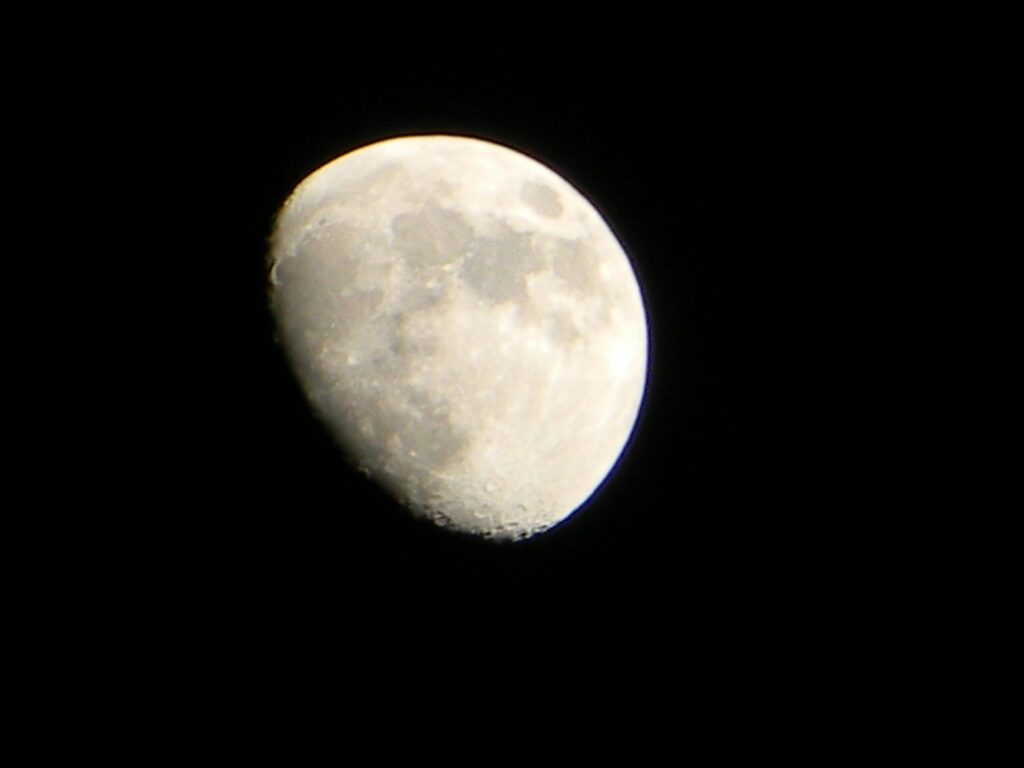
Astrophotography by Lexis Johnson.
The lunar surface reflects much more than sunlight. The glimmering lunar floor shines with the possibilities to answer questions about our history and future that have never been found before. The enigmatic celestial object that provides ethereal radiance from the terrae to the maria known as our Moon is the key to understanding our starry nights. There is more to offer beyond the level of the surface or regolith (that’s a little lunar humour for you!) of this barren and desolate satellite.
The launch of Artemis II is fast approaching, blasting off as soon as February 2026. Only a few months away. There has been discourse as to how this mission can contribute to us here on Earth, and I am here to tell you that the benefits we will receive are enough to blast our future to new lengths. This mission prepares us for Artemis III, where we will be sending a crewed mission to the lunar surface.
The last time that there was a crewed mission to the Moon was in 1972. That’s 52 years ago. [4] Just think about how much technology has evolved since then; not to mention how much the Canadian Space Agency has contributed to lunar and stellar exploration. Humanity has big plans for this next age of space innovation, and Canada is at the forefront.
Canada has announced plans for a Canadarm 3 for Gateway, which is the one of the latest on a collaborative project between NASA and the ISS to launch us deeper into space than ever before. This robotic arm will contribute immensely to the space station from maintenance, to inspection and repairs, and to allowing scientific research in lunar areas. Canadarm will also help astronauts complete taskings during spacewalks. The reach that the Canadarms has made for scientific exploration parallels Canada’s contribution towards the lunar robotics industry, building on the magnificent legacy that Canada has built in space robotics. Canadarm will be built right here at home in Brampton, Ontario by the company MDA who also built Canadarm and Canadarm II, but truly hundreds of Canadian companies are coming together to make this possible. That’s the power of Canada. [1]
Now Canada is going even further. Thanks to the immeasurable talent in Canadian robotics, Canada is set to launch two astronaut flights to the Moon. Our very own Jeremy Hansen of London, Ontario will be a part of Artemis II, making him the very first Canadian to ever go to the moon. [2] Talk about one small step for Canada, and one giant leap for Canadian-kind.
One of the most commonly-asked questions the general population seems to have is: why are we sending these rovers and people to the moon? What do we have to gain from these missions? Well, let me tell you about the Jupiter-sized amount of knowledge we can bring back in this rocket.
We will bring back information around the distance between the Orion crew module and neighbouring stars, helping to create a more sharply defined map of our cosmic universe. We can further open opportunities for further space exploration to Mars and beyond. Once we know more about spaceflight and the Moon, more possibilities will arise for spaceflight that can deepen human understanding than ever before. [5] Using the information we gather about the lunar geology and regolith, we can further advance the first-ever Canadian lunar rover to search for water-ice on the Moon, which is also a prime ingredient for future space missions. [3] Through Artemis II, we will also gain crucial information about the gravity between the Moon and the Earth, learning about the propulsion and how this contributes to the “free ride” home. If we want to step on the lunar surface for Artemis III, this is the mission that will get us there. [5]
384,400. That is the number of kilometres that stands between our Earth and the Moon. All the planets in our solar system could fit between them, side-by-side. Yet humanity is ready to make this journey once again. The sound of the engines blasting off on Artemis II will sound like entering a new chapter in space exploration, and Canada has been a major contributor to making this possible. The time we are living in holds so much potential for deeper space travel; our generation will soon see lunar and planetary space exploration deeper than ever believed possible, to infinity and beyond. When I look up at the Moon, the future shines back at me. It looks bright.
Works Cited
[1] Canadian Space Agency. “About Canadarm3.” Canadian Space Agency, / Gouvernement du Canada, 22 Sept. 2025, www.asc-csa.gc.ca/eng/canadarm3/about.asp
[2] Canadian Space Agency. “Astronaut Jeremy Hansen’s Biography.” Canadian Space Agency, / Gouvernement du Canada, 22 Sept. 2025, www.asc-csa.gc.ca/eng/astronauts/canadian/active/bio-jeremy-hansen.asp
[3] Canadian Space Agency. “Canada’s Role in Moon Exploration.” Canadian Space Agency, / Gouvernement du Canada, 5 June 2025, www.asc-csa.gc.ca/eng/astronomy/moon-exploration/canada-role.asp
[4] Canadian Space Agency. “The Artemis II Mission.” Canadian Space Agency, / Gouvernement du Canada, 17 Oct. 2025, www.asc-csa.gc.ca/eng/missions/artemis-ii/mission.asp
[5] “NASA’s First Flight with Crew Important Step on Long-Term Return to the Moon, Missions to Mars.” NASA, NASA, 19 Sept. 2025, www.nasa.gov/missions/artemis/nasas-first-flight-with-crew-important-step-on-long-term-return-to-the-moon-missions-to-mars/
About the author
Lexis Johnson is a current senior year high school student. She is a passionate space enthusiast and communicator and enjoys reading and writing about these cosmic topics. She has always had a love for the stars and excitement to share this love with others.