
Tampons in Microgravity: Inclusive Design Meets Space Research
By Yosamin Esanullah & Julia Bayer-Cheung
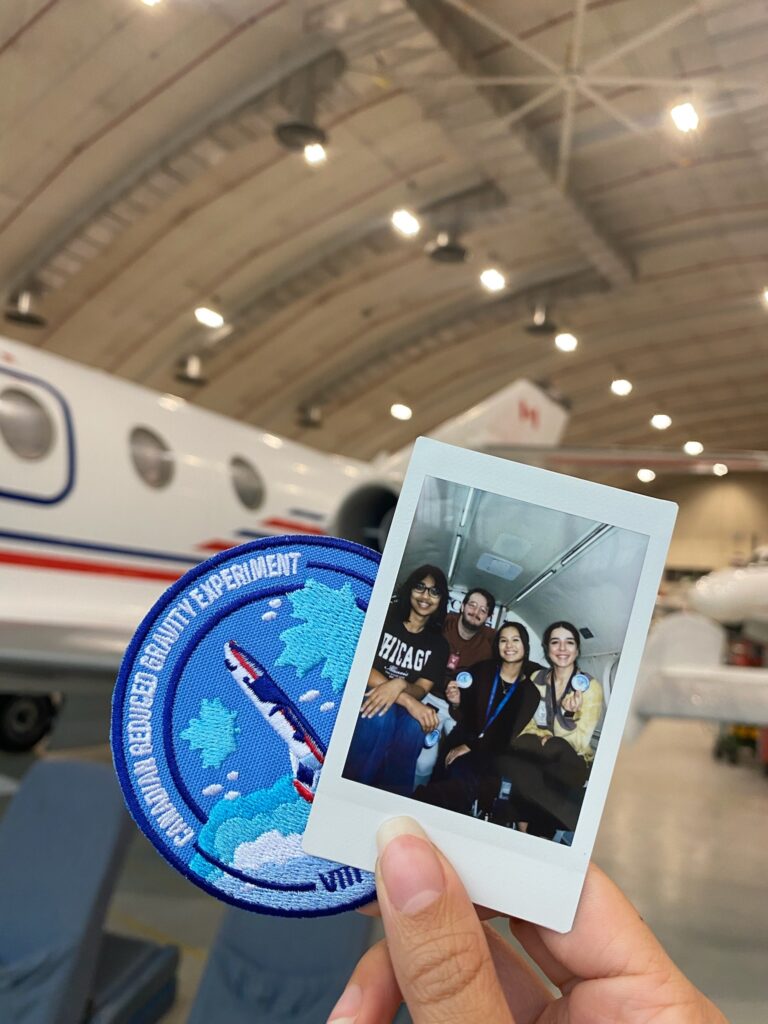
Image by Julia Bayer-Cheung, Test Lead of Space MENstruators.
An Engineering Problem
Consider the following scenario:
A crew of eight female astronauts has been selected for the first human mission to Mars. The spacecraft, life-support systems, and onboard infrastructure must support every aspect of human physiology, including menstruation, over a multi-year mission.
Why an all-female crew? From an engineering standpoint, female astronauts, on average, have lower body mass and less caloric requirements (they eat less). These differences translate into reduced mass, volume, and resource demands, which are critical constraints for a multi-year interplanetary mission.
Let’s establish a few assumptions:
1.) The total mission duration is three years, accounting for transit to Mars, surface operations, and return.
2.) All crew members continue to experience regular, monthly menstrual cycles.
3.) Menstruation lasts an average of five days per cycle for each astronaut, with medium flow.
4.) Menstrual suppression via hormonal birth control is not an option, due to unresolved questions about long-term estrogen and progesterone exposure in high-radiation environments.
The question then becomes:
How must mission planning, life-support systems, waste management, and space infrastructure be designed to safely, hygienically, and sustainably support these realities?
This is what our student design team, Space MENstruaautors (or Space MENs for short), was created to address. More specifically, we are studying the droplet dynamics and fluid motion of a blood simulant during tampon removal in microgravity.
The Scientific Problem
Despite the fact that more than 75 women astronauts have participated in space missions to date [1], menstruation remains one of the least studied aspects of human spaceflight.
In practice, the most common solution currently used by female astronauts is menstrual suppression [2]. While effective for many, this approach is not universally suitable and carries known risks even on Earth, including abnormal uterine bleeding, ovarian cyst formation, and increased cancer risks.
In space, these concerns are compounded by uncertainty. The long-term effects of hormone exposure under chronic radiation conditions are not fully understood, making suppression a less straightforward solution than it may initially appear.
For astronauts who don’t suppress their menstrual cycles, tampons and sanitary pads remain the primary hygiene products used in space. Yet, there is a striking absence of published best practices, and a lack of research on how menstrual blood behaves in space during removal and disposal in microgravity [3]. This lack of data introduces risks related to hygiene, contamination, and waste management, especially for life support systems like water filtration which can’t handle biological materials like blood.
At the core of this problem is fluid behavior.
Menstrual blood does not behave like water, especially not in microgravity. It is a non-Newtonian fluid, meaning its viscosity changes under stress. Depending on shear conditions, it can behave like a liquid or a gel, influenced by clotting, cellular content, and protein structures. In microgravity, where surface tension and cohesion dominate over gravity, these properties become even more consequential.
Uncontrolled droplets, surface deposition, or aerosolized menstrual blood particles could poste both biological and engineering hazards. Understanding how menstrual fluids disperse during tampon removal, and how different tampon designs retain or release fluid under microgravity conditions, is therefore essential.
Designing the Experiment: Unexpected Considerations
Our platform to conduct our experiment was CAN-RGX: The Canadian Reduced Gravity Experiment Design Challenge. It’s a national competition that offers post-secondary students the opportunity to design, build, and fly scientific experiments in a real microgravity environment. CAN-RGX is run in collaboration with Students for the Exploration and Development of Space (SEDS) Canada, the Canadian Space Agency (CSA), and the National Research Council (NRC).
Selected teams get to fly their payloads aboard the NRC’s Falcon 20 aircraft, which has been modified to perform parabolic flight maneuvers that simulate weightlessness on Earth. To learn more about parabolic flights, check out the Canadian Space Agency’s website.
By simulating tampon extraction in microgravity, we aimed to capture high-speed video footage and physical splatter sheet data from any released droplets. This setup included two medical-grade synthetic vagina models—affectionately dubbed synginas—a blood simulant, pumps, linear actuators, cameras, and removable splatter sheets lining the experimental housing.
Designing this system forced us to confront questions we never expected to debate in an engineering context.
Should the synginas be heated?
We debated between using commercially available sexual health products which often came with heating elements (yes, you know exactly what we’re talking about), against anatomically correct medical models. Ultimately, we decided to opt -out for temperature as a controlled variable for a more accurate vaginal model.
What blood simulant should we use?
Using real blood samples was out of the question, since it would disqualify us from the competition. Saline, which is commercially used to test tampon absorbency, failed to capture the clotting behavior of menstrual blood. We even experimented with homemade mixtures of cornstarch, water, and food dye before identifying TrueClot, a commercial blood simulant designed to replicate coagulation properties for first-responder training.
What constitutes “medium flow,” and how much force is exerted during tampon removal?
These deceptively simple questions proved some of the hardest to quantify. We conducted extensive preliminary testing to determine flow rates and actuator speeds that produced realistic extraction without failure. Too little force caused the tampon to remain lodged in the syngina; too much resulted in what we came to call a “tampon tornado.”
Through multiple iterations and design reviews with professional engineers and mission specialists from the NRC, CSA, and SEDS, we arrived at a flight-certified system capable of producing meaningful, repeatable data.

Logo by Angela Pepito, Mechanical Lead of Space MENstruators
The Flight Campaign
Despite a year of preparation, nothing fully prepares you for parabolic flight.
We quickly learned through word of mouth that nearly 50% of first-time flyers experience motion sickness. Our experiment required four mission specialists to reset and operate the system between parabolas, meaning that nausea was not just uncomfortable, it threatened our data collection.
(Spoiler alert: two of us did get sick. A combined total of six vomiting incidents occurred mid-flight. According to the flight engineers, they had never seen a team get so sick and continue working so effectively.)
We did encounter technical issues: our cameras overheated during one trial, resulting in lost footage. Despite this and the vomiting, we miraculously managed to procure 90% of the data we aimed for!
While the technical challenges of designing and flying the experiment were significant, many of the most impactful obstacles emerged outside the lab.
As a small, student-led design team working at the intersection of engineering, human health, and social stigma, navigating administrative support structures proved to be an ongoing challenge. Institutional processes are often optimized for more conventional projects with well-established precedents, and our work did not always fit neatly within existing categories. Securing approvals, resources, and guidance, required persistence, flexibility, and support from our mentors.
Perhaps the most fundamental barrier, however, was the absence of existing research and established best practices. More fundamentally, we were working in a research landscape with little prior data to reference. In many ways, our project was not just an experiment—it was an attempt to define how such experiments could be conducted at all.
This absence of precedent is not accidental. It reflects broader patterns in whose bodies are prioritized in scientific inquiry and whose needs are treated as edge cases. While frustrating at times, these barriers reinforced the importance of the work itself.
By documenting our process and lessons learned, we hope to contribute a small but meaningful foundation for future teams to build openupon, reducing friction for those who ask similar questions down the line.
Conclusion: Towards an Inclusive Future
As (temporarily) Earth-bound humans, we are endlessly curious about the intimate realities of living and functioning in space. How do astronauts go to the bathroom? How do they take showers? Do they really drink recycled sweat and urine? Those questions reflect more than curiosity, they reveal our desire to see ourselves in our astronauts, to imagine how our own bodies are would be in their place.
And while many aspects of daily life in microgravity have been explored, other questions remain largely unasked. Perhaps they are considered awkward, personal, or inappropriate to discuss during a public broadcast with an astronaut.
When certain experiences go unstudied or undiscussed, it reinforces that some bodies are expected to adapt quietly to systems that are not designed for them. This isn’t just in space science, all engineering is shaped by social precedent, cultural comfort, and long-standing assumptions about who technology is for.
The theme Starry Nights speaks to the instinct that drives us to look upward and imagine new possibilities. But imagination alone is not enough to sustain human presence beyond Earth. To live among the stars requires us to pay attention to the fragile, biological and social truths that accompany us as humans.
Confronting these intimate realities is not a diversion from exploration; it is a prerequisite for it. If we hope to build a future in space that is sustainable, equitable, and genuinely human, then we must be willing to design for all.
Acknowledgements
Space MENstruators would like to thank the NRC, CSA, and SEDS for making this research possible. We extend our gratitude to Joni for donating hundreds of tampons and funding our cameras, and to our mentors and administration at UBC Okanagan for their support.
Works Cited:
[1] “Women’s History Month: Celebrating Women Astronauts 2024 – NASA,” NTRS – NASA Technical Reports Server, Mar. 01, 2024. https://www.nasa.gov/history/womens-history-month-celebrating-women-astronauts-2024/
[2] N. K. Reame, “Toxic Shock Syndrome and Tampons: The Birth of a Movement and a Research ‘Vagenda,’” PubMed, 2020. https://www.ncbi.nlm.nih.gov/books/NBK565591/
[3] “Women’s Health in spaceflight: Life beyond low earth orbit – NASA technical reports server (NTRS),” NASA. [Online]. Available: https://ntrs.nasa.gov/citations/20240006986. [Accessed: 20-Oct-2024]
About the authors
Yosamin Esanullah is a recently graduated mechanical engineering major with an aerospace concentration, the inaugural Team Captain of Space MENs, and currently works as a Junior Systems Engineer.
Julia is a final-year mechanical engineering student at the University of British Columbia Okanagan, the current Team Lead of Space MENs, and works with the Sustainable Projects Group. Together, they contribute to advancing inclusive and human-centered engineering research through the Space MENs initiative.

Photograph from Sabhya Arora, UBCO Phoenix News. The team, from left to right: Julia Bayer-Cheung, Jeena Javahar, James Ropotar, Yosamin Esanullah, Tarek Alkabbani, Heanan Brody Bird, and Angela Pepito. Not shown in photo: Mehak Parihar and Gurnoor Chawla.